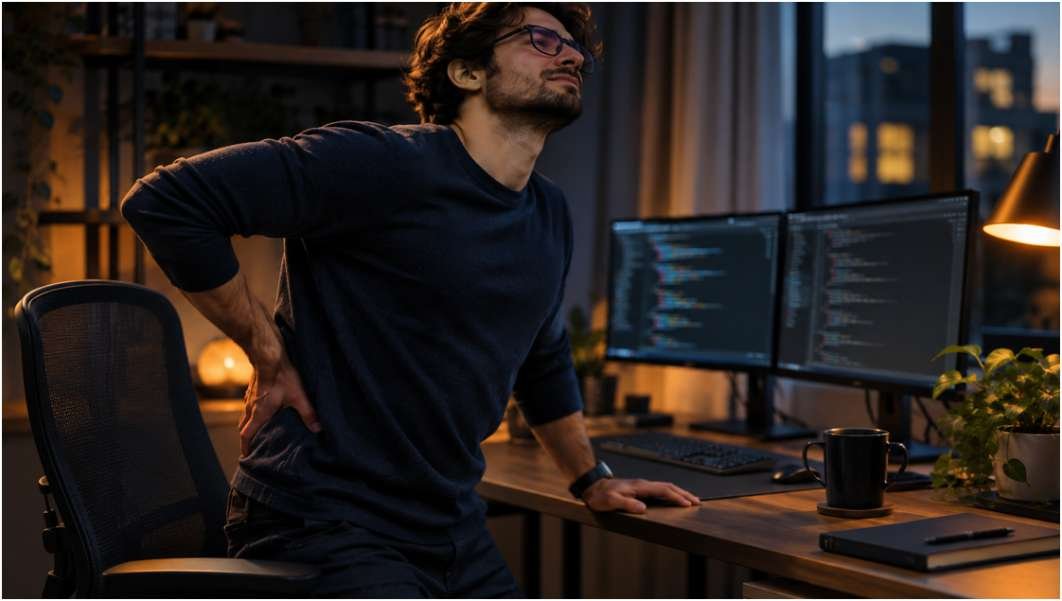
The most effective way to relieve lumbar stiffness from coding marathons is a 10-minute daily routine combining hip flexor stretches, spinal mobility, and glute activation. Six months ago, a three-hour debugging session left me unable to stand upright without gripping my desk edge. Practicing targeted lower back exercises for developers who sit at a desk all day completely eliminated that afternoon ache within three weeks.
Prolonged sitting locks your hips into constant flexion and switches off your core and glutes. Your lumbar spine then absorbs mechanical loads it was never designed to carry alone.
Why Coding Marathons Wreck Your Lumbar Spine
When you lean toward your monitor during a deep-work sprint, your pelvis tilts backward and flattens your natural lumbar curve. According to the National Institute of Neurological Disorders and Stroke (NINDS), mechanical stress on spinal discs and supporting ligaments drives most chronic low back pain.
Your hip flexors shorten like tight rubber bands after four hours in an ergonomic chair. Meanwhile, your gluteus maximus experiences reciprocal inhibition—neurological shorthand for falling asleep on the job. When you finally stand up to grab coffee, those tight hip flexors yank your pelvis forward and compress your lower vertebrae.
Upper-body habits compound this lower-body tension. If you also hunch over a trackpad, learning how to fix tech neck pain caused by looking down at laptops will keep your entire kinetic chain aligned. Even the OSHA Computer Workstations eTool emphasizes that static postures restrict blood flow regardless of how expensive your chair is.
My 21-Day Compile-Time Mobility Experiment
I used to ignore mobility work until pain forced me away from my keyboard. To break that habit, I tied movement directly to my development workflow for 21 straight days. Every time I pushed a branch or waited on a slow CI/CD pipeline, I ran one desk reset.
| Tracking Metric | Day 1 Baseline | Day 10 Check-In | Day 21 Result |
| Daily Sitting Duration | 9.5 hours | 9.0 hours | 9.0 hours |
| Afternoon Pain Score (1–10) | 7 / 10 | 4 / 10 | 1.5 / 10 |
| Compile-Time Resets Completed | 0 per day | 4 per day | 5 per day |
| Evening Floor Routine Adherence | 0% | 80% | 95% |
My afternoon stiffness dropped by half within ten days without reducing my total coding hours. By day 21, I finished evening sprints with zero throbbing along my beltline.
Quick At-Desk Reset Every 60 to 90 Minutes
You do not need a yoga mat or extra floor space to decompress your spine between meetings. Perform these three desk stretches for lower back stiffness right next to your workstation every 60 to 90 minutes.
Seated Figure-Four Stretch
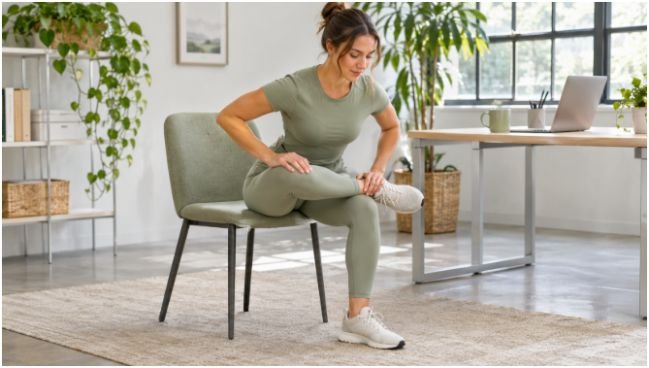
Sit upright at the front edge of your chair with both feet flat on the floor. Cross your right ankle over your left knee and keep your chest lifted. Hinge forward slightly at your hips until you feel a deep stretch in your outer right glute.
Hold this position for 30 seconds per side for two full sets. Avoid rounding your upper back to reach lower; keeping your spine neutral isolates the piriformis muscle that often irritates the sciatic nerve.
Seated Cat-Cow
Place both palms flat on your knees while sitting tall. Inhale deeply as you pull your chest forward, gently arching your lumbar spine and tilting your pelvis anterior. Exhale slowly as you tuck your tailbone and round your upper and lower back away from the desk.
Complete 10 slow, controlled repetitions for two sets. This rhythmic pumping action restores synovial fluid movement across stiff spinal joints.
Standing Hip Hinge (Good Mornings)
Stand up behind your chair with your feet hip-width apart and knees slightly unlocked. Place your fingertips behind your ears and push your hips straight backward until your torso sits nearly parallel to the floor. Keep your spine completely flat throughout the descent.
Drive your hips forward to return to standing and repeat for 12 reps across two sets. This drill wakes up dormant hamstrings and teaches your hips to hinge instead of your lower back. Pair this standing break with daily wrist and hand stretches to protect your forearms during heavy sprint weeks.
End-of-Day 10-Minute Floor Routine for Glute Activation
Once you close your IDE for the evening, spend ten minutes on your living room rug undoing eight hours of chair posture. Rest 30 seconds between each set and focus on slow, deliberate muscle contractions rather than rushing through reps.
Glute Bridges
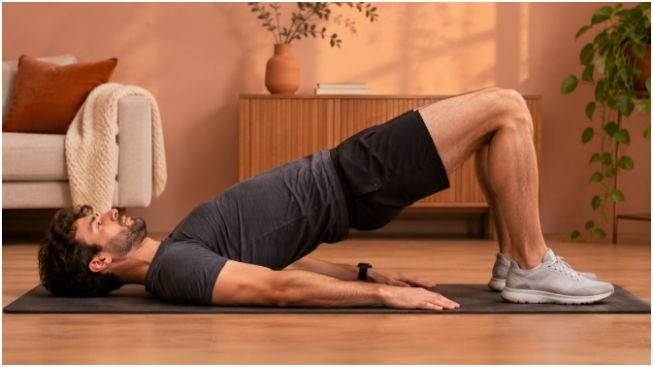
Lie flat on your back with your knees bent, feet planted hip-width apart, and heels pulled close to your glutes. Press hard through your heels and squeeze your glutes to lift your hips toward the ceiling. Stop once your body forms a straight diagonal line from your shoulders to your knees.
Pause for two full seconds at the top without hyperextending your lower back. Lower your hips slowly and complete three sets of 12 to 15 repetitions. As noted by the Mayo Clinic, strengthening core and glute stabilizers creates a natural muscular corset around vulnerable lumbar discs.
Bird-Dog
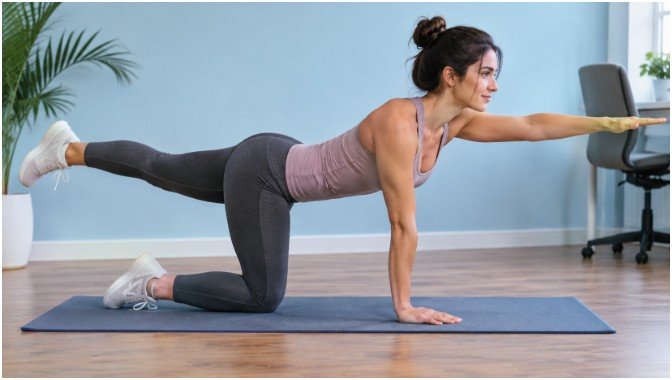
Start on all fours on your mat with your wrists stacked directly under your shoulders and knees under your hips. Brace your abdominal muscles as if preparing for a light punch to keep your spine neutral. Slowly extend your right arm straight forward and your left leg straight back until both run parallel to the floor.
Keep your hips completely square to the ground—imagine balancing a mug of coffee on your lower back. Hold the extended position for two seconds before returning to the start and switching sides. Perform three sets of 8 to 10 reps per side.
Kneeling Hip Flexor Stretch
Kneel on your right knee over a folded towel or exercise mat, planting your left foot flat in front at a 90-degree angle. Tuck your pelvis slightly under by squeezing your right glute firmly. Shift your weight gently forward just an inch or two until you feel an intense stretch across the front of your right hip.
Hold this stretch for 30 to 45 seconds per side for two sets. Most developers lean too far forward and arch their lower back, which completely misses the psoas muscle. Keep your ribcage stacked over your pelvis the entire time.
Child’s Pose with Side Reach
Kneel on the floor, touch your big toes together, and sink your hips backward toward your heels. Walk your fingertips straight forward as far as possible to lengthen your entire spine. Next, walk both hands 45 degrees to the left until you feel a deep pull along your right latissimus dorsi and lower back.
Breathe deeply into your right ribcage for 30 seconds before walking your hands across to the right side. Complete two sets per side to release tight flank muscles that tug laterally on your lumbar vertebrae.
Muscle Stiffness vs. Nerve Strain: When to Stop Immediately
Knowing the difference between normal muscular tightness and structural nerve irritation keeps a minor ache from turning into a major injury. Dull, broad stiffness across your beltline typically eases within two minutes of gentle movement.
Stop exercising immediately and consult a physician if you experience any of these warning signs outlined by the Cleveland Clinic:
- Sharp, electric, or shooting pain radiating down one or both legs
- Numbness, pins-and-needles tingling, or burning sensations in your glutes, calves, or feet
- Sudden muscle weakness when lifting your foot or standing on your tiptoes
- Loss of bowel or bladder control alongside severe lumbar pain
Never try to stretch through sharp nerve pain, as aggressive flexion can worsen a bulging lumbar disc.
Frequently Asked Questions
1. How often should developers stretch their lower back at work?
Stand up and perform a two-minute mobility reset every 60 to 90 minutes to prevent hip flexor shortening and disc compression.
2. Are standing desks enough to fix lower back pain for programmers?
No, standing still all day simply trades hip flexion for lower-limb fatigue unless you alternate postures and strengthen your glutes.
3. What is the single best exercise for lower back stiffness from sitting?
Glute bridges deliver the highest return because they simultaneously stretch tight hip flexors and wake up dormant glute muscles.
4. Can tight hamstrings cause lower back pain when sitting at a desk?
Yes, tight hamstrings pull downward on your pelvis, flattening your lumbar spine and overloading your lower back muscles.
Refactor Your Posture Before Your Next Sprint
Treat your spine like production code: small, frequent commits prevent catastrophic system failures down the road. Set a recurring 75-minute timer on your workstation right now, and knock out one set of Seated Figure-Four stretches the next time your build compiles.