Staring blankly at a beige office wall for 20 seconds never cured my afternoon screen headaches. When I started pairing distant focal points with targeted oculomotor drills, my burning eyes and end-of-day blur disappeared within a week.
Most desk workers treat the classic screen-break formula as a passive timeout. However, practicing the best 20-20-20 rule exercises for reducing monitor eye fatigue requires active muscle engagement to unlock frozen focusing lenses and replenish evaporated tear film.
Why Staring at a Wall Fails to Stop Computer Vision Syndrome
Standard advice tells you to look 20 feet away every 20 minutes for 20 seconds. While that breaks your focal lock on nearby pixels, passive gazing leaves your eyelids static and your extraocular muscles tight.
According to the American Optometric Association, sustained near-field viewing forces the eye’s ciliary muscle into continuous contraction. Over an eight-hour workday, that constant tension triggers accommodative spasm, brow ache, and delayed focus shifting.
My 14-Day Dual-Monitor Oculomotor Experiment
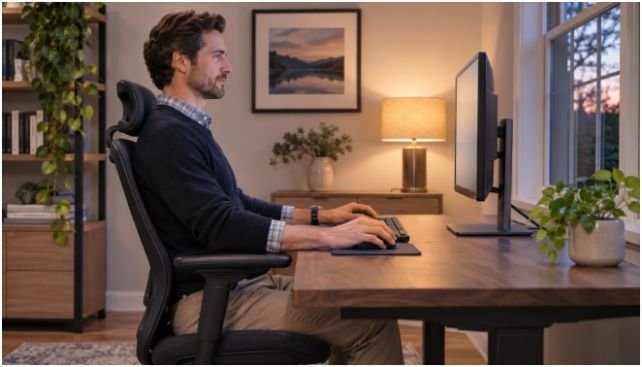
Last month, I tracked my visual fatigue across two consecutive seven-day work sprints while editing technical documentation on dual 27-inch monitors. During Week 1, I used a desktop chime every 20 minutes and simply looked out my window for 20 seconds. By 4:00 PM each day, I still logged moderate ocular dryness and needed lubricating drops twice per shift.
During Week 2, I replaced passive window-gazing with five structured micro-drills inside that exact same 20-second window. Evening eye burning dropped from six days out of seven to zero, and my afternoon reading speed stayed sharp past 6:00 PM.
The 5 Best 20-20-20 Rule Exercises for Reducing Monitor Eye Fatigue

You do not need to perform all five movements during a single break. Rotate one or two of these 20-20-20 rule exercises for reducing monitor eye fatigue every 20 minutes so your visual system gets balanced relief across the day.
1. Conscious Slow Blinking (Meibomian Gland Reset)
Reading dense text on a glowing display suppresses your natural blink rate by more than 50 percent. Research highlighted by the American Academy of Ophthalmology confirms that partial, incomplete blinks prevent your eyelids from sealing tear moisture across the cornea.
Close your eyes slowly, pause for two full seconds, and gently squeeze your lids together before opening. Repeat this deliberate cycle 10 times during your 20-second pause. That light squeeze stimulates the meibomian glands along your eyelid margins, releasing protective oils that stop tears from evaporating prematurely.
2. Near-to-Far Focus Shifting (Ciliary Muscle Release)
Locking your gaze at a fixed 24-inch monitor distance paralyzes your lens accommodation reflex. To break that spasm, you must force your ciliary muscle to contract and relax rapidly across contrasting depth planes.
Hold your thumb 10 inches in front of your nose and lock your focus onto the skin ridges for three seconds. Immediately shift your gaze to a specific object at least 20 feet away—like a tree branch or distant doorframe—for three seconds. Alternate between your thumb and the 20-foot target four times to restore full focusing elasticity.
3. Warm Palming (Photoreceptor Recovery)
Even well-calibrated IPS and OLED panels bombard your retinas with continuous photon energy. When my eyes feel hot or light-sensitive after back-to-back video calls, warm palming delivers instant sensory relief.
Rub your palms together briskly for five seconds until friction generates noticeable warmth. Cup your hands gently over your closed eyes without pressing against your eyeballs, blocking out every sliver of ambient light. Take four slow diaphragmatic breaths in complete darkness to let overstimulated photoreceptors reset.
4. Figure-Eight Tracking (Extraocular Tension Relief)
Tracking horizontal lines of code or spreadsheet columns restricts your six extraocular muscles to repetitive micro-movements. Smooth pursuit tracking breaks that rigid pattern and restores coordination between both eyes.
Pick an imaginary point on a wall 15 to 20 feet away and trace a massive sideways figure eight—an infinity symbol—using only your eyes. Keep your jaw relaxed and your head completely stationary. Trace slowly clockwise for 10 seconds, then reverse direction for the remaining 10 seconds to release oblique muscle tightness.
5. Directional Eye Stretches (Ocular Blood Flow Boost)
Static screen posture reduces micro-circulation around the orbital socket. Controlled end-range eye movements gently stretch the rectus muscles that steer your gaze up, down, and sideways.
Without tilting your chin, look straight up toward the ceiling for two seconds, then shift straight down toward the floor for two seconds. Next, look far left and far right for two seconds each. Finish your 20-second interval with one slow clockwise eye circle and one counterclockwise circle to ease orbital stiffness.
Workspace Tweaks That Multiply Your 20-Second Breaks

Exercises repair visual fatigue, but poor desk geometry recreates strain the moment you look back at your screen. Pair your break routine with three physical adjustments to protect your ocular surface between intervals.
First, automate your reminders using a subtle menu-bar timer or smartwatch vibration. Relying on willpower fails the moment you enter deep focus, turning 20-minute intervals into two-hour marathons.
Second, audit your screen angle and viewing distance. Following OSHA computer workstation guidelines, place your monitor roughly an arm’s length away—between 20 and 40 inches—with the top bezel at or slightly below eye level. Looking slightly downward keeps your upper eyelids lower, shielding more of your cornea from dry indoor air.
Third, eliminate harsh contrast mismatches between your display and your room. If you work after sundown, learn how to prevent digital eye strain during late night coding sessions by matching display luminance to ambient room lighting and positioning screens perpendicular to windows. Maintaining healthy tear film stability, as emphasized by the National Eye Institute, depends just as much on environmental humidity and glare control as it does on regular breaks.
Frequently Asked Questions About 20-20-20 Eye Exercises
1. How often should I do 20-20-20 rule exercises for reducing monitor eye fatigue?
Perform one or two targeted eye exercises every 20 minutes during continuous screen work for a full 20 seconds.
2. Can eye exercises permanently fix blurry vision from computer screens?
No, they relieve temporary ciliary muscle spasm and dryness, whereas persistent blur requires a comprehensive optometrist exam.
3. Is warm palming safe if I wear contact lenses at my desk?
Yes, provided you cup your palms gently over the orbital bone without pressing directly against your closed eyelids or lenses.
4. What if my office room is smaller than 20 feet long?
Look through an open doorway down a hallway or gaze out a window at any distant exterior landmark beyond 20 feet.
Give Your Ciliary Muscles a Coffee Break
Your eyes were engineered to scan wide horizons, not wrestle with glowing 12-point fonts for ten hours straight. Set a recurring 20-minute timer on your computer right now, pick two drills from this list—start with conscious slow blinking and near-to-far focus shifting—and test them across your next three work blocks.