
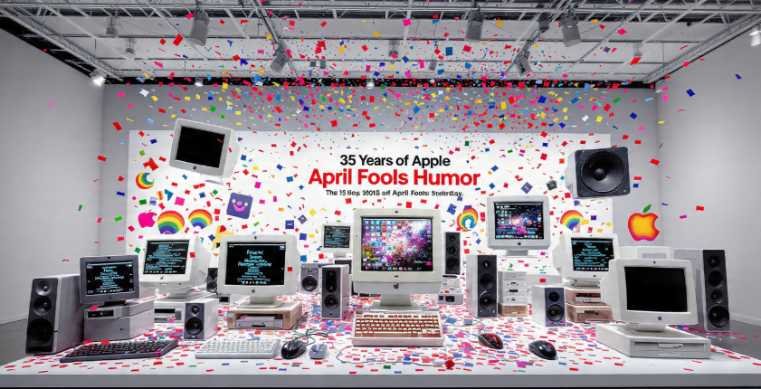
April 1 holds a special place in Apple history. It’s not just Apple’s founding date in 1976—it’s also April Fools’ Day. That coincidence has inspired decades of clever, absurd, and sometimes surprisingly believable pranks tied to the Apple ecosystem.
Looking back at the classic roundup from RandomMaccess, it’s clear that while Apple itself hasn’t leaned into April Fools’ Day as aggressively as companies like Google, the Apple community has more than made up for it. Developers, fans, and publications have created a rich tradition of humor that reflects both love for the brand and a willingness to poke fun at it.
Here’s a nostalgic tour through some of the most memorable Apple-themed April Fools’ jokes over the years.
The Origins: Clarus the Dogcow (1989)
One of the earliest and most iconic Apple jokes came in 1989 with the introduction of Clarus the Dogcow. Created by Mark Harlan, this parody technical note explained the mysterious “dogcow” image used in Apple software.
The humor was wonderfully absurd. The document described dogcows as two-dimensional creatures that avoid being seen by turning sideways. It even gave the creature a name—Clarus—which went on to become a beloved inside joke in Apple culture.
What made this prank special wasn’t just the humor—it felt authentic. It mimicked Apple’s developer documentation so well that it blurred the line between joke and reality.
Expo Mischief: Rosebud Technology (1990)
At the rescheduled Macworld Expo in 1990, attendees encountered a fictional company called Rosebud Technology. It came complete with booths, flyers, and products that sounded just plausible enough.
The fake products included PowerLink, which supposedly allowed Macs to communicate over electrical wiring, and Silicon Valet, which promised control over household devices through your computer.
The brilliance of this prank was its scale. It wasn’t just an article—it was an immersive experience that fooled attendees in real time.
Software Meets Satire: Caffeine Manager (1992)
In 1992, Apple itself got in on the fun with a fake press release announcing “Caffeine Manager,” a system extension that would connect Macs to coffee machines and soda dispensers.
The humor was subtle but sharp. The fictional spokesperson, “Mike ‘Ro’ Soft,” was a playful jab at Microsoft, Apple’s longtime rival.
This prank captured the tech culture of the time, blending real product language with ridiculous functionality.
The Absurd Side of Tech: MacTech’s “Manly Fixes” (1997)
By the late ’90s, April Fools’ jokes had taken a more outrageous turn. MacTech Magazine published a piece suggesting that computer problems could be fixed using power tools—or even a handgun.
The joke escalated quickly, describing a scenario where a bullet passed through a printer without affecting its performance. It was ridiculous, over-the-top, and clearly not meant to be taken seriously.
Still, it reflected a growing trend: tech humor becoming more exaggerated and self-aware.
Space-Age Dreams: Deep Space Mac (2000)
At the turn of the millennium, rumors spread that NASA might adopt Apple technology for space missions. The story, attributed to a “college friend” working at the Jet Propulsion Laboratory, had just enough detail to seem credible.
Of course, it was all fiction. But it played on a common theme in Apple fandom—the idea that Apple products were advanced enough to handle even the most extreme environments.
Merger Madness (2001–2002)
The early 2000s saw a wave of fake corporate announcements. One rumor claimed that Adobe and Macromedia would merge, only to be acquired by Apple. Another suggested that Microsoft would buy Apple entirely.
These jokes worked because they tapped into real industry tensions and possibilities. Years later, Adobe would indeed acquire Macromedia—proving that sometimes, April Fools’ jokes aren’t entirely far-fetched.
Browser Wars Humor: Safari-Only Web (2003)
In 2003, a clever prank exploited server-side scripting to block users who weren’t using Apple’s Safari browser. Visitors using other browsers were redirected to a message implying the site had gone Mac-only.
It was a playful jab at browser wars and platform loyalty, especially during a time when Safari was newly introduced.
The Ultimate Shock: Steve Jobs Resigns (2003)
Perhaps one of the most believable—and unsettling—pranks was a fake announcement that Steve Jobs had stepped down from Apple.
The statement was crafted in a tone that felt authentic, making it momentarily convincing. It showed how powerful a well-written prank could be, especially when it touched on something people cared deeply about.
Pushing Limits: The G5 Cubed (2004)
Tech publications also joined the fun. Macworld announced a fictional “PowerMac G5 Cubed,” a triple-processor machine that pushed Apple’s hardware ambitions to absurd levels.
The joke played on the industry’s obsession with performance specs, exaggerating it to the point of humor.
Why Apple Pranks Stand Out
Unlike some companies that use April Fools’ Day purely for marketing, Apple-related pranks often come from the community. Developers, writers, and fans create jokes that reflect insider knowledge and shared experiences.
This gives the humor a different tone—it’s less about promotion and more about culture.
The Fine Line Between Joke and Reality
What makes many of these pranks memorable is how close they come to reality. Whether it’s a fake merger, a fictional product, or a satirical feature, the best jokes feel just believable enough.
In some cases, reality even catches up. Features that once seemed absurd—like smart home control or advanced connectivity—are now commonplace.
A Tradition Worth Celebrating
Over the years, April Fools’ Day has become a unique lens through which to view Apple’s evolution. It highlights not just the company’s innovations, but also the creativity and humor of its community.
From Clarus the Dogcow to futuristic Macs, these jokes remind us that technology doesn’t always have to be serious. Sometimes, a little absurdity can reveal just as much about a company as its real products.
Final Thoughts: Humor in the Apple Ecosystem
Apple may not officially embrace April Fools’ Day in a big way, but its influence is everywhere in the jokes created around it. The combination of a passionate user base and a culture of innovation makes Apple the perfect subject for clever, playful satire.
As long as technology continues to evolve, so will the jokes that accompany it. And if history is any guide, Apple will always be at the center of the fun.